
Automated Pigging System for Lubricant Blending at Gulf Oil Ltd., Chennai
Introduction
In the lubricant manufacturing industry, maintaining product quality, minimising material wastage, and ensuring accurate blending are essential for efficient production. Manual material handling and pipeline transfer can create challenges such as cross-contamination, product loss, inaccurate additive dosing, and extended cleaning cycles.
To address these challenges, Gulf Oil Ltd., Chennai, partnered with IUS Equipment Pvt. Ltd. to modernise its blending and material transfer operations. IUS implemented an automated blending and dual Pigging System integrated with PLC and HMI controls. The solution improved product recovery, batch accuracy, operational safety, and overall production efficiency.
Project Overview
- Client: Gulf Oil Ltd.
- Location: Chennai, Tamil Nadu, India
- System Type: Automated Blending and Pigging System
- Product: Lubricant Oil Additives
- Pipeline Size: 3 inches
- Number of Lines: 1
- Average Sources: 1
- Average Destinations: 2
Challenges Faced by Gulf Oil Ltd.
Before implementing the automated solution, Gulf Oil’s Chennai facility relied on a manual blending and material transfer process. The existing hose-based transfer arrangement created several operational difficulties.
The major challenges included:
- Cross-contamination risks: Residual material in pipelines increased the possibility of contamination between batches.
- Product wastage: Pipeline hold-up resulted in valuable base oil and additives being left behind after transfers.
- Inaccurate additive dosing: Manual blending made it difficult to maintain consistent measurements.
- Long cleaning cycles: Manual cleaning increased batch changeover time and affected production efficiency.
- Operator safety concerns: Frequent manual handling increased operational risks.
- Limited traceability: The absence of automated batch recording made documentation and quality monitoring difficult.
Gulf Oil required an integrated solution that could automate blending, improve material recovery, and provide better control over the entire production process.
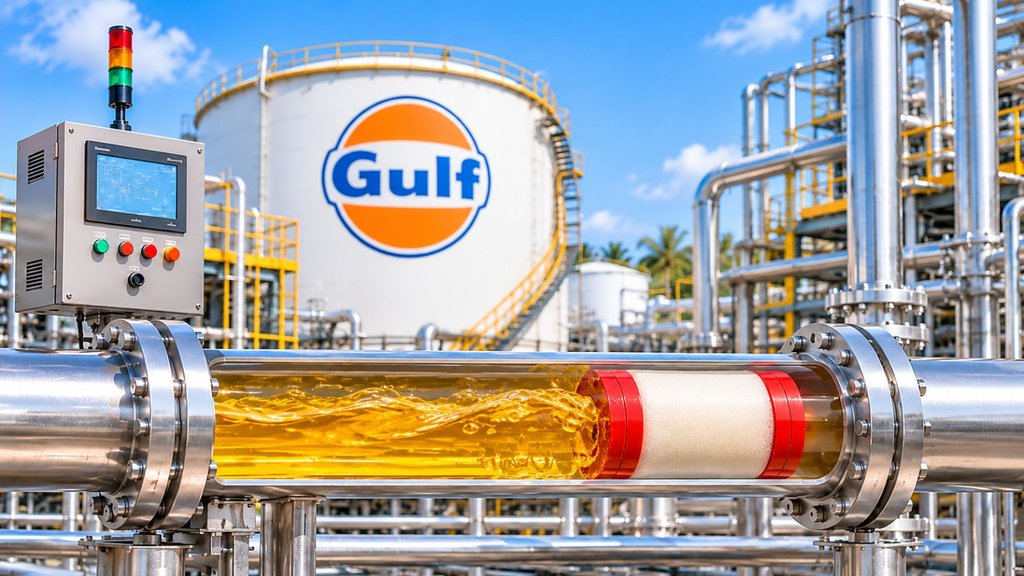
IUS Pigging Solution: Automated Blending and Dual Pigging System
IUS Equipment Pvt. Ltd. implemented a comprehensive automation solution to improve the facility’s blending and material transfer operations. The system combined automated blending, dual pigging technology, accurate dosing, and PLC-HMI integration.
1. Fixed Pipeline Installation
The existing hose-based transfer arrangement was replaced with fixed MS pipelines featuring long-radius 5D elbows. This provided a more secure and reliable transfer arrangement while reducing leakage risks and maintenance requirements.
The improved pipeline design also supported efficient pig movement and product recovery.
2. Automated Dual Pigging System
An automated dual Pigging System was installed with dedicated launching and receiving stations. The stations were equipped with actuated valves and instruments to support controlled pigging operations.
High-density polyurethane pigs were introduced into the pipeline to push residual lubricant and additives towards the destination. This helped minimise pipeline hold-up and recover valuable product during batch changeovers.
The system was integrated with PLC and HMI controls, allowing operators to manage operations, monitor system status, and execute changeovers more efficiently.
Three-way, fully actuated T-port valves were also installed to minimise residual material retention within the valves.
3. Automated Blending and Mixing
An agitator with a VFD-controlled motor was installed on the blending tank to ensure uniform mixing of base oil and additives.
The automated mixing arrangement improved process control and helped maintain consistent blending conditions across production batches.
4. Accurate Dosing Through Load Cells
Load cells were incorporated into the system to enable weight-based material measurement. This allowed accurate dosing, real-time monitoring, and better control over the quantity of base oil and additives used.