
How IUS Pigging Improved Peanut Butter Recovery with a Hygienic Pigging System
In the food processing industry, product recovery, hygiene, and production efficiency are essential for maintaining profitability. Manufacturers handling viscous products such as peanut butter often face challenges with pipeline cleaning, product wastage, and lengthy changeover times. A well-designed pigging system can help overcome these challenges by recovering residual products from pipelines while improving operational efficiency.
IUS Pigging provided an innovative hygienic pigging solution for M/S Ruparel Foods Pvt. Ltd., a peanut butter manufacturer and exporter based in Mahuva, Gujarat, India. The customized system was designed to recover more than 99% of the product remaining in the pipeline, reduce cleaning time, and increase productivity.
About Ruparel Foods Pvt. Ltd.
M/S Ruparel Foods Pvt. Ltd. is a peanut butter manufacturing and exporting company based in Mahuva, Gujarat. The company required an efficient solution to address product recovery and pipeline cleaning challenges in its existing production setup.
Peanut butter is a highly viscous product that can be difficult to remove from pipelines, particularly at room temperature. Traditional cleaning methods require significant manual effort, resulting in longer downtime and reduced production efficiency.
To address these challenges, IUS Pigging developed a customized hygienic pigging system incorporating heat tracing, specialized components, and an innovative manifold arrangement.
Project Overview
The project involved implementing a hygienic pigging solution tailored to Ruparel Foods’ peanut butter processing requirements.
Project specifications:
- Client: M/S Ruparel Foods Pvt. Ltd.
- Location: Mahuva, Gujarat, India
- Industry: Food Processing
- Product: Peanut Butter
- System Type: Hygienic Pigging System
- Pipeline Size: 2 inches
- Number of Lines: 3
- Average Number of Sources: 2
- Average Number of Destinations: 1
The primary objective was to improve product recovery, simplify pipeline cleaning, minimize cross-contamination risks, and reduce production downtime.
Challenges Before Installing the Pigging System
Before the installation, Ruparel Foods faced several operational challenges associated with transferring peanut butter through its production pipelines.
1. Product Loss Inside Pipelines
After product transfer, a considerable amount of peanut butter remained inside the pipeline. Recovering this residual product was difficult using conventional methods, leading to avoidable product wastage.
2. Time-Consuming Manual Cleaning
Peanut butter’s viscous nature made pipeline cleaning particularly challenging. The existing process involved removing piping from its position and manually cleaning the interiors. This procedure required considerable labor and took more than 30 minutes per cleaning cycle.
3. Extended Changeover Time
Cleaning the pipeline between production batches delayed subsequent operations. Longer changeovers reduced the time available for productive manufacturing activities.
4. Risk of Cross-Contamination
When multiple products are transferred through shared pipelines, residual material from a previous batch can contaminate the next product if the line is not adequately cleared and cleaned.
5. Reduced Production Efficiency
Manual cleaning, product losses, and extended downtime affected overall productivity. Ruparel Foods needed a solution that could address these issues without requiring a completely separate pipeline for every product transfer route.
The IUS Pigging Solution
To overcome these challenges, IUS Pigging designed a customized hygienic pigging system specifically suited to peanut butter processing.
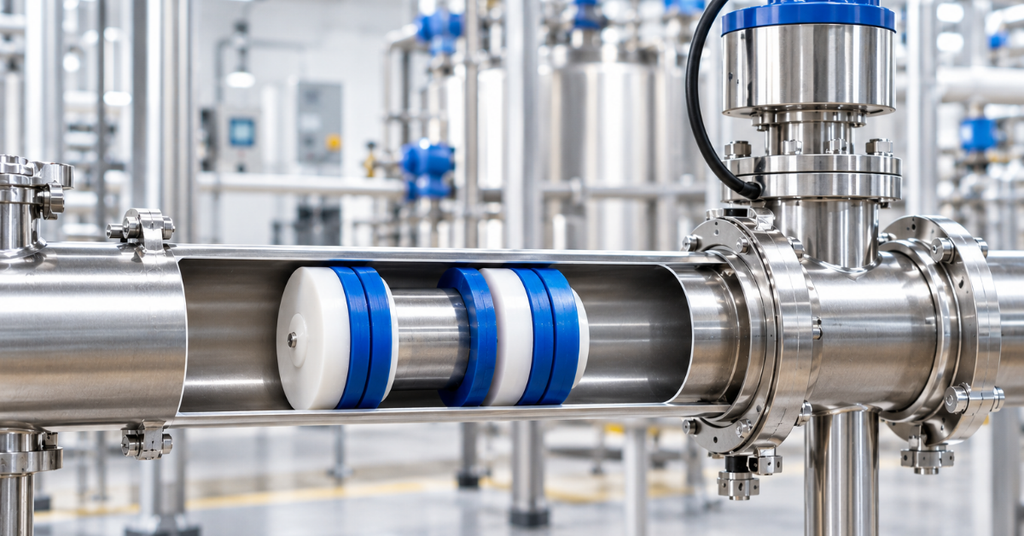
A pigging system uses a specially designed device called a pig that travels through a pipeline to push residual product toward the destination. This helps recover material that would otherwise remain inside the pipe.
For Ruparel Foods, IUS Pigging combined this principle with heating, specialized components, and an automated operating cycle.
1. Hygienic Design for Product Recovery
The system was engineered to recover the peanut butter remaining inside the pipeline after product transfer. By moving the pig through the line, the system pushes residual product toward the destination, reducing product loss and improving material utilization.
2. Integrated Heat Tracing
Because peanut butter is highly viscous, maintaining suitable product temperature was an important consideration.
IUS Pigging integrated a heat-tracing system to help maintain the product’s viscosity for easier transfer. This also helped improve pigging efficiency and reduce the time required to complete the process.
3. Customized Manifold for Multiple Sources
The project involved three pipelines, with one line requiring the handling of two sources and one destination.
To address this configuration, IUS Pigging developed a customized manifold that enabled the required product transfer and pigging operations.
This arrangement allowed the system to manage the necessary transfer routes while supporting efficient pipeline operation.
4. Redesigned System Components
IUS Pigging’s in-house research and development team refined key components, including the launcher, receiver, and valves.
These modifications were designed to support the specific operating requirements of the application and enable reliable product transfer and pig movement.
5. Automated Pigging Cycle
The system incorporated an automated cycle to simplify operations and reduce dependence on manual intervention.
The customized design allowed the pigs to move between their designated positions during product transfer, product recovery, and return operations.
How the Pigging Cycle Works
The system operates through four main stages.
Step 1: Product Transfer
Peanut butter is transferred from the source to the destination using the configured pipeline and two pigs positioned on the launcher and receiver sides.
Step 2: Product Recovery
The launcher-side pig is moved to push the residual peanut butter toward the destination, recovering the product remaining inside the pipeline.
Step 3: The Pig Reaches the Receiver
Following the recovery operation, the pig is received at the receiver position as part of the configured cycle.
Step 4: Return to Home Position
The pig is returned to its designated home positions, preparing the system for the next operating cycle.
This automated sequence supports product recovery and helps reduce the time and manual effort required for pipeline cleaning and changeovers.
Results Achieved After Installing the Pigging System
The customized solution delivered significant improvements in product recovery, cleaning time, and production efficiency.
1. More Than 99% Product Recovery
The installed pigging system achieved product recovery of more than 99% of the pipeline volume.
This resulted in approximately 20–25 litres of recovered peanut butter per pigging cycle, helping reduce product wastage and improve material utilization.
2. Cleaning Time Reduced from Over 30 Minutes to 3 Minutes
Before installation, manual pipeline cleaning required more than 30 minutes.
After implementing the hygienic pigging system with heat tracing, the reported cleaning time was reduced to approximately 3 minutes.
This significantly shortened the cleaning process and allowed production operations to resume sooner.
3. Approximately 90% Improvement in Changeover Time
The solution delivered approximately 90% improvement in changeover time compared with the previous process, according to the project results.
By reducing the need for manual pipeline dismantling and cleaning, the system helped simplify transitions between production batches.
4. Reduced Cross-Contamination Risk
The system was designed to remove residual product from the pipeline and support the use of shared lines for different product transfers.
This helped reduce the risk of cross-contamination when combined with the appropriate cleaning and sanitation procedures required for food processing.
5. Increased Productivity by 15%
The project results indicated that Ruparel Foods achieved a 15% increase in productivity following the implementation.
Reduced cleaning time, improved product recovery, and approximately 30 minutes less downtime per cycle contributed to more efficient production operations.
Why a Hygienic Pigging System is Valuable for Food Manufacturers
Food manufacturers handling viscous products can benefit from a properly designed pigging solution in several ways.
- Improved product recovery: Pushes residual material out of pipelines, reducing product losses.
- Shorter cleaning cycles: Reduces the time and labor required for conventional pipeline cleaning.
- Better production efficiency: Minimizes downtime between batches and product transfers.
- Reduced contamination risk: Helps clear residual products from shared pipelines when supported by suitable sanitation procedures.
- More flexible production: Allows appropriately designed pipelines to serve multiple product transfer routes.
- Lower operating costs: Reduced product wastage, cleaning effort, and downtime can improve overall operational economics.
The exact benefits depend on the product’s characteristics, pipeline configuration, temperature requirements, and system design.
Conclusion
The Ruparel Foods project demonstrates how a customized hygienic pigging solution can address important challenges in peanut butter manufacturing. By combining product recovery technology, heat tracing, an innovative manifold, redesigned components, and automation, IUS Pigging developed a solution tailored to the client’s production requirements.
The results included more than 99% product recovery, a reduction in cleaning time from over 30 minutes to approximately 3 minutes, around 90% improvement in changeover time, and a reported 15% increase in productivity.
For food manufacturers looking to improve product utilization, reduce downtime, and streamline pipeline operations, a properly engineered pigging system can be a valuable investment.
IUS Pigging continues to develop customized pigging solutions designed to help industries improve production efficiency, recover valuable products, and support more sustainable manufacturing operations.