
How a Pigging System Helped ALPLA Achieve Maximum Product Recovery in High-Viscosity Lines
Significant product losses can occur in pipelines while producing high-viscosity goods like toothpaste, lotions, and hair gels, especially during product changeovers.
Manufacturers can save waste, increase productivity, and save operating expenses by recovering the product that is still in the pipeline. This case study describes how the technical team of IUS Pigging addressed pipeline losses and enhanced product recovery at ALPLA’s manufacturing facility by installing a specialized pigging system.
About ALPLA
The Austrian business ALPLA has a manufacturing plant in Silvassa, Gujarat, India. The plant manufactures a variety of high-viscosity goods, such as toothpaste, hair gels, and lotions, and offers contract manufacturing services to Hindustan Unilever Ltd.
These items have to be moved through pipelines during the production process in order to get to the filling machines. A significant amount of product stayed in the pipeline during product changeover. Product waste, more cleaning needs, and higher operating expenses were the outcomes of this.
The Challenge: Product Loss During Changeovers
Product changeovers are an important part of manufacturing operations, especially when multiple products are processed through the same pipeline. However, high-viscosity products can adhere to the internal surfaces of pipelines, making conventional product transfer less effective.
For ALPLA, this meant that a significant quantity of toothpaste and other products remained inside the pipeline after transfer. The resulting product loss affected yield and also increased the amount of cleaning required between production runs.
The primary objective was to reduce pipeline losses, recover as much product as possible, and improve the efficiency of the overall transfer and changeover process.
The Objective
The technical team of IUS Pigging worked with ALPLA to understand the existing manufacturing process and identify a practical solution that could be integrated without major changes to the existing infrastructure.
The key objectives were to:
- Minimize product losses during changeovers
- Improve product recovery from pipelines
- Reduce cleaning requirements
- Improve production efficiency
- Reduce waste generation
- Provide a flexible and commercially viable solution
The Customized Pigging System Solution
In order to examine the current procedure and create a solution appropriate for the plant’s operational needs, the technical team of IUS Pigging visited ALPLA’s Silvassa manufacturing facility.
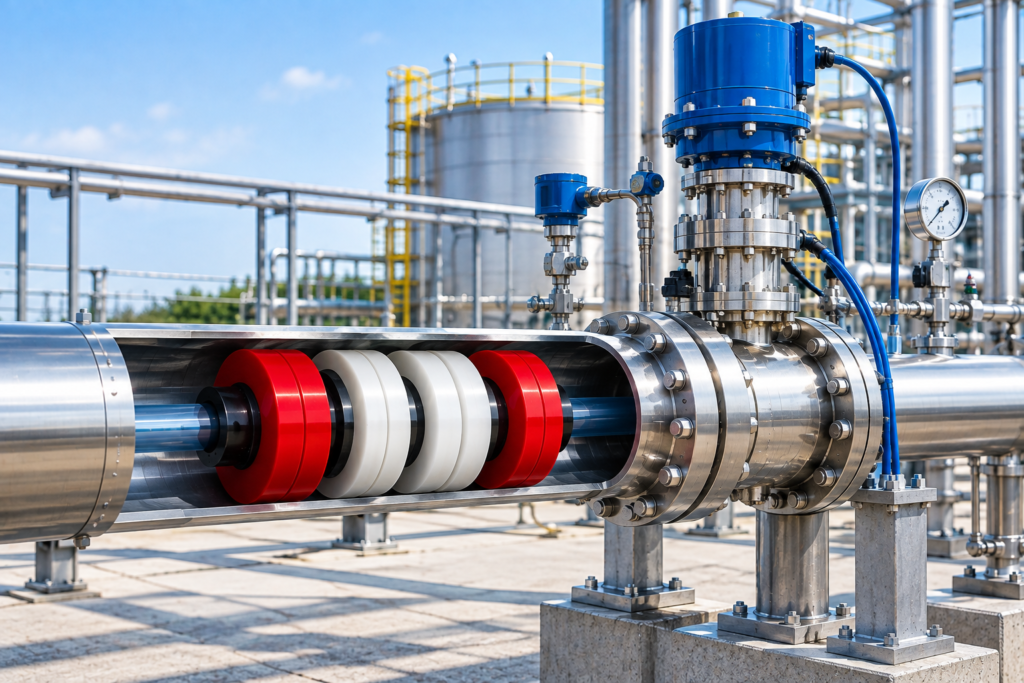
The suggested pigging system consisted of thirteen receivers linked to the filling machines and three portable launchers. Greater flexibility during manufacturing was made possible by the portable design, which allowed operators to remove and attach the launcher at multiple locations as needed.
IUS created a manual system with manual ball valves, a pressure gauge, and a pressure relief valve (PRV) in consideration of ALPLA’s requirements. The pig detecting sensor, which showed the pig’s location inside the launcher and receiver, was the only electrical part.
By using this strategy, ALPLA was able to take use of product recovery technologies while maintaining a straightforward, adaptable, and economical system.
How the System Worked
The implementation process was designed to work alongside ALPLA’s existing product transfer process.
1. Product Transfer
The operator first transferred the product through the existing manufacturing process. Once the transfer was completed, the pump was switched off.
2. Launcher Installation
After the pump was stopped, a blind was placed to seal the required location. The portable launcher was then attached, and the existing destination auto valve and air inlet valve were opened.
3. Controlled Pig Movement
The pig was moved through the pipeline using the available air supply. The movement was controlled based on the hopper’s level sensor.
When the hopper level was high, the pig stopped. As the product level decreased, the pig resumed its movement, helping recover the product remaining inside the pipeline.
4. Pig Detection and Retrieval
Once the pig reached the receiver, the pig detecting sensor indicated its position to the operator.
The pig was then sent back to the launcher. The launcher could subsequently be detached and moved to a dedicated cleaning area along with the pig.
5. Cleaning and CIP
After the pigging operation was completed, the launcher was detached and cleaned. The blind was then placed, followed by the Clean-in-Place (CIP) process to maintain the required level of system cleanliness.
Results and Benefits
Following installation, ALPLA conducted trials and observed significant improvements in the manufacturing process.
The pigging system enabled almost complete product recovery from the pipeline, substantially minimizing product wastage during changeovers.
The major benefits included:
Almost Complete Product Recovery:
Product remaining inside the pipeline could be recovered instead of being lost during changeovers, helping improve overall product yield.
Reduced Product Waste:
By recovering the residual product, ALPLA was able to reduce waste generation and make better use of the materials already introduced into the production line.
Time Savings:
The improved transfer and recovery process reduced the time associated with product changeovers and cleaning.
Improved Productivity:
Efficient product recovery helped the manufacturing process operate more effectively and supported higher productivity.
Reduced Contamination:
The controlled recovery and cleaning process helped minimize the possibility of product contamination between production cycles.
Cost Savings:
Reducing product losses and optimizing cleaning requirements contributed to operational cost savings.
Support for Sustainability:
Lower product wastage means fewer resources are lost during manufacturing, helping support the plant’s waste-reduction and sustainability objectives.
Installation Completed in Just 3 Days
One of the notable aspects of the project was the speed of implementation. IUS successfully incorporated the solution at ALPLA’s plant in just 3 days.
ALPLA was impressed by how quickly the system was installed and integrated into the existing process. More importantly, the benefits became apparent from the very first product transfer after installation.
The quick implementation demonstrated that a customized solution does not necessarily require extensive modifications to an existing manufacturing setup.
Conclusion
The successful implementation of a pigging system at ALPLA’s Silvassa plant addressed a significant challenge associated with pipeline product losses during changeovers.
By combining portable launchers, multiple receivers, controlled pig movement, and a simple manual operating system, IUS developed a solution that matched ALPLA’s technical and commercial requirements.
The project resulted in almost complete product recovery, reduced waste, improved productivity, lower cleaning requirements, and cost savings. The 3-day installation also demonstrated the importance of developing a practical solution around the customer’s existing manufacturing process.
For manufacturers handling high-viscosity products such as toothpaste, creams, gels, and similar materials, an appropriately designed pigging solution can help recover valuable products from pipelines while improving efficiency and reducing waste.
IUS continues to provide customized pigging solutions designed around specific production requirements, pipeline configurations, and product characteristics.