
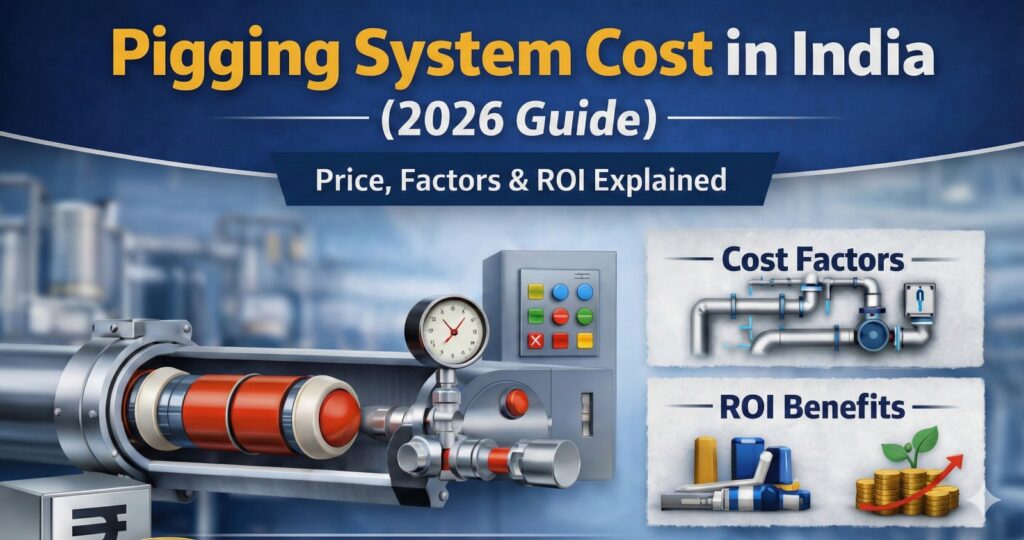
Pigging System Price in India (2026 Guide)
Pigging systems don’t come with one fixed price tag like a standard machine, because every factory’s production line layout is different. But to help you plan, here’s a realistic idea of the pigging system price in India based on common project requirements:
- A manual pigging system usually costs less, depending on pipeline size and number of product lines.
- A semi-automatic solution is generally priced higher.
- For large plants that require PLC control, safety integration, and automated operation, the automatic pigging system is priced according to the system requirements.
- If the application is for food, dairy, beverages, or cosmetics, the hygienic pigging system cost is typically higher because of sanitary design requirements. The price also depends on automation and the number of product lines.
Why Pigging System Cost Varies from Plant to Plant
Pigging system pricing changes because pigging is not a one-size product. It’s an engineered system designed around your pipelines and production process. One factory may need a simple single-line product recovery setup, while another may need multiple lines with routing, diverter valves, automation, and safety systems.
The first major factor is pipeline diameter and length. Larger pipelines require stronger pigging valves, larger pigs, and more robust launching and receiving stations. Longer pipelines can also add complexity depending on bends and routing.
The second cost driver is the number of transfer lines you want to include. A pigging setup for one line is obviously cheaper than a multi-line integrated system. In industries like paint manufacturing and bulk chemical production, multiple pipelines connect mixing vessels, storage tanks, and filling stations. So the system design becomes more advanced, which impacts cost.
Automation is another major contributor. Plants that choose manual pigging often do it to keep initial cost low. But plants that want faster operation, repeatable results, and reduced operator dependency usually go for semi-automatic or fully automatic systems. That’s why fully automated pigging comes with control panels, sensors, and pig detection, increasing cost but improving overall efficiency.
Industry standards also make a difference. Hygienic pigging systems have special design expectations because they are meant to prevent contamination and enable easy cleaning. That’s why applications like dairy, beverages, and cosmetics often require higher-grade stainless steel, smoother finishes, and sanitary fittings, raising the final pigging system cost.
Even your product type impacts pricing. Pigging paint industry is different from the pigging for milk industry. High-viscosity and sticky products like adhesives, coatings, and thick emulsions require better sealing, a stronger pig design, and a higher recovery focus, which can change system requirements.
Finally, installation and commissioning affect the budget as well. Sometimes pipeline modifications are needed for adding launchers, receivers, and valve stations. A proper system also includes testing, operator training, and commissioning support.
Hidden Costs You Should Consider
When people search “pigging system price in India,” they often expect only equipment pricing. But pigging projects sometimes include additional costs depending on how complex the factory layout is.
For example, pipeline modifications, additional instrumentation, structural supports, spare pig sets, and optional AMC maintenance packages can become part of the total project cost. These may not always be huge, but they matter in complete budgeting.
That’s why it’s always better to estimate the full system cost after sharing basic line details and production requirements.
Pigging System ROI: Is it Really Worth the Investment?
The return on investment of a pigging system is mainly driven by one benefit product recovery. Every time a product batch ends, pipeline contents remain inside. Pigging pushes that remaining product back into the process, reducing losses significantly.
For industries like paint, food, lubricants, and chemicals, even a small daily product recovery can convert into major savings monthly. In the dairy and beverage industries, pigging helps in recovering products while reducing cleaning cycles and contamination risks.
Pigging systems also improve operational speed. Traditional flushing takes time. It also consumes water/solvent and generates waste. Pigging reduces line cleaning duration and supports faster batch changeovers, which directly reduces downtime, and downtime is expensive for any production facility.
In many plants, pigging also reduces cleaning media usage (water and chemicals). This helps reduce wastewater and disposal costs and supports sustainability goals, something more industries are focusing on in 2026.
So when factories calculate ROI, they usually compare:
- Cost of product loss before pigging
- Cost savings from recovered product
- Reduced cleaning time and downtime
- Reduced water/solvent usage
For many manufacturing units, pigging pays back faster than expected, depending on volumes and changeover frequency.
Pigging System vs. Traditional Flushing
Traditional flushing looks cheap on paper because it needs low investment. But over time, it becomes costly due to repeated product loss, cleaning media costs, longer shutdown times, and more waste handling.
A pigging system feels like a bigger investment in the beginning, but it reduces daily losses and makes operations smoother. That’s why more and more factories are upgrading to pigging systems in India, especially in the paint and hygienic industries.
How to Get an Exact Pigging System Price for Your Plant
To get a correct quotation, suppliers usually ask for basic details like pipeline diameter, approximate length, number of lines, and product type. A small sketch of pipeline routing is often enough. Once these inputs are shared, the supplier can design a practical system and provide accurate cost estimation.
Conclusion
In 2026, a pigging system is no longer treated as an optional upgrade. It has become a smart investment for industries that want better product recovery, faster changeovers, lower waste, and better process efficiency.
The pigging system price in India depends on your production setup, but the ROI depends on one simple truth: the value of what you are losing every day. If your plant faces repeated product wastage, high cleaning costs, or frequent changeovers, pigging becomes not just a cost but a long-term saving system.
FAQs
1. What is the average pigging system price in India?
Pigging system cost depends on pipeline size, number of lines, automation and product type.
2. Is a pigging system suitable only for paint industries?
No. Pigging is widely used in the paint, coatings, and chemical industries. It is also extremely useful for dairy, beverages, cosmetics, adhesives, and high-value liquid products where recovery matters.
3. What affects pigging system prices the most?
Pipeline diameter and length, number of transfer lines, automation level (manual vs. automatic), product type, and hygienic requirements are the biggest factors affecting cost.
4. Does the pigging system really give a good ROI?
Yes, especially when frequent changeovers happen. Pigging recovers products from pipelines, reduces cleaning time, and cuts downtime. In many cases, ROI becomes visible within months depending on production volume.
5. Can I install pigging on existing pipelines?
Yes, pigging systems can be integrated into existing pipeline setups. Some modifications might be required depending on routing, line design, and installation space.